
Pip's Way Home: The Quiet Little Puzzle Game I Always Wanted to Make
I have a soft spot for games that don't shout at you.
You know the type. No timers ticking in the corner. No flashing "LEVEL FAILED" screen. No energy bar telling you to come back in four hours. Just a small world, a gentle problem, and the time to think it through.
For a long while I kept telling myself I would make one of those someday. Pip's Way Home is that someday. It's out now on both the App Store and Google Play, and I want to tell you a bit about what it is, how it came together, and why I made the choices I made.
So, what is Pip's Way Home?
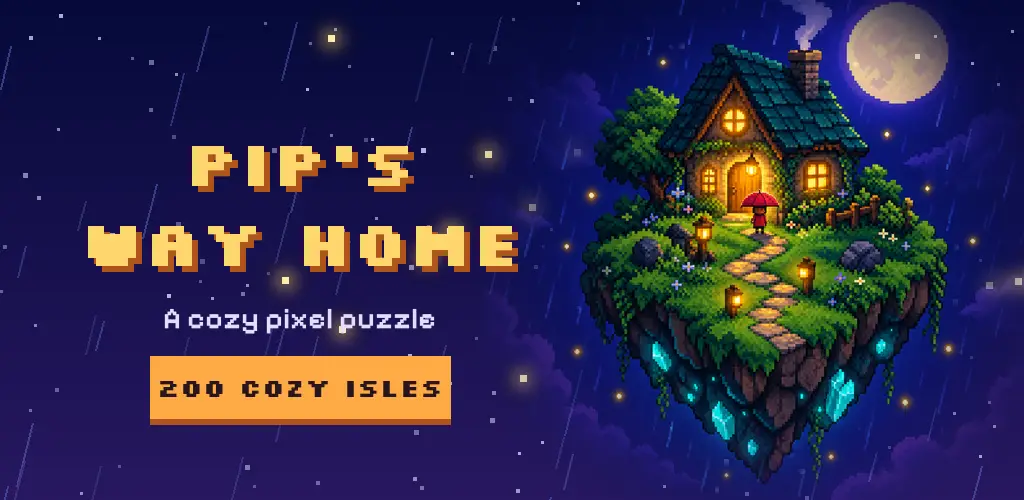
Pip is a tiny traveler who has wandered a little too far from home. The world Pip lives in is made of small floating islands drifting in the sky, and each island is covered in path tiles that don't quite line up.
Your job is simple to explain and surprisingly fun to figure out. You tap the tiles to rotate them, and you try to connect a clear path from where Pip is standing to the way home. When the path is complete, Pip walks it. That little walk at the end of each puzzle is honestly one of my favorite parts of the whole game. There's something very satisfying about watching a small character follow the road you just built for them.
The early islands are easy, almost relaxing. Later ones ask you to slow down and actually look before you tap. It never gets cruel, though. That was a rule I set for myself from the very first day.
Why pixel art?
I grew up on games with chunky pixels, and I still think pixel art has a warmth that's hard to get any other way. A tree is a handful of greens. A cloud is a soft white smudge. Your brain fills in the rest.
The art style was actually inspired by a post I came across on X. It was one of those images where I stopped scrolling and just stared at it for a while. Soft colors, tiny details, a feeling of calm. I knew right away that I wanted Pip's world to feel like that. Not the same picture, of course, but the same mood. Cozy. Floating. A little bit dreamy.
Building it, one island at a time
Pip's Way Home didn't even start with that name. For most of its early life it was called Floating Isles, which, to be fair, describes the game pretty well. But the more I worked on it, the more I realized the game wasn't really about the islands. It was about Pip. It was about getting someone small back to where they belong. So the name changed, and honestly the game started to feel more like itself after that.
The very first version was a rough prototype I could play in a browser. Just squares that rotated and a dot that tried to walk home. It was ugly. It was also fun, and that was all I needed to know.
After that, I rebuilt it properly as a native Android game. I've always preferred native development. It takes more effort, but the game feels smoother and behaves the way a phone game should. Later I brought it over to iOS the same way, and Pip's Way Home became my very first game on the App Store. That one felt like a real milestone for me.
More than just levels
Once the core puzzle felt good, I wanted to give players a reason to keep coming back that didn't involve nagging them.
So there's a sky map where you can see all the islands you've visited and the ones still waiting for you. I love opening it and seeing how far Pip has traveled. It turns a list of levels into an actual journey.
The islands are grouped into chapters, and each chapter has its own feel. New colors, new little details, a slightly different mood. It helps the game breathe. Just when you get comfortable, the world shifts a little.
There are collectibles tucked around the islands too. They're completely optional. If you just want to solve puzzles and move on, you can. But if you're the kind of player who likes poking into every corner, there's a small reward waiting for you.
And then there's the daily isle. Every day there's a fresh island to solve, the kind of thing you can do with your morning tea. No pressure if you miss a day.
The music matters more than you'd think
A cozy game without the right music is just a puzzle game with pastel colors.
I wanted the soundtrack to feel like a soft background hum. Something you notice when you stop to listen but never something that pulls you away from the puzzle. The plan was at least five calm tracks, so you're not hearing the same loop over and over as you move through the chapters.
If you play with headphones on, I think you'll get what I was going for. It's the kind of music that makes you breathe a little slower.
What it was like to ship it
I'll be honest. Releasing a game as a solo developer is a strange feeling. You spend weeks living inside this little world, fixing tiny things nobody else would ever notice, and then one day you press a button and it's out there. Strangers can download it. Strangers can judge it.
I didn't set out to make the biggest game or the hardest game. I wanted to make something that felt like a deep breath. If someone plays a few islands before bed and puts the phone down feeling a little calmer, that's a win for me.
About ads and playing ad free
Pip's Way Home is free to download and play. To keep it that way, the game does show ads. I know ads in a cozy game can feel a little out of place, and that's something I think about a lot.
That's why I'm working on an option to remove ads with a one-time purchase, starting with the iOS version. If you love the game and want a completely calm, uninterrupted experience, you'll be able to have that. And if you'd rather play for free, that's absolutely fine too. Every player helps the game grow either way.
What's next for Pip
For now, I've decided to put my focus fully on this one game. I have plenty of other ideas sitting in my notebook, but I'd rather give Pip's Way Home the attention it deserves than rush on to the next thing.
That means more polish, more islands over time, and listening carefully to what players say. If a puzzle feels unfair or there's a little feature you wish the game had, please tell me.
Give it a try
If you like slow, thoughtful puzzles, soft pixel art, and games that let you play at your own pace, I think you'll enjoy Pip's Way Home. It's free on both iPhone and Android, so go help a tiny traveler find the way back.
And if you do play it, I'd really love to hear what you think. You can reach me through this website anytime. Every message, good or bad, helps me make the game better.
Thanks for reading, and thanks for supporting a small indie developer. It genuinely means a lot.